
Email templates
You can use our email templates to promote your pension scheme and help your employees understand their pension.
Our email template wording has been approved by Royal London for use in its current format, please only alter highlighted or bracketed wording. Royal London is not responsible for any further changes you make to the content.
Engagement resources
Use these ready made campaign materials to introduce your employees to their new workplace pension, promoting the benefits of joining and how they can make the most of their pension.

Pension checklist
Our checklist highlights top tips to help your employees review their pension.
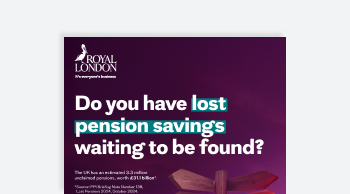
Finding lost pensions poster
Use this poster to encourage your employees to find any lost or old pensions.

How a pension works leaflet (for net contribution schemes)
Introduces their workplace pension and highlights the benefits the Group Personal Pension Plan offers.

How a pension works leaflet (for salary exchange schemes)
Introduces their workplace pension and highlights the benefits the Group Personal Pension Plan offers.

Saving for your future booklet
Shows the ways that people can save for their future retirement.

What's stopping you? booklet
Support to answer some of the common objections about joining the pension scheme.

Existing member poster
Use this poster to tell your employees how they can review their pension plan and check it's on track.

Cost of Delay
This leaflet highlights the effect of
putting off saving into a pension and the benefits of starting to save early.
Videos
How a pension works
Share this video with your employees to help them understand the basics of their Royal London pension. The link opens in a new window.
Video transcript
Your employer has set up a pension plan with Royal London to help you save for your retirement.
Each time you save into your plan, so will your employer.
You'll also receive tax relief from the government.
This can help to boost your pension savings.
You can make single contributions into your plan at any time.
Any single contributions you make will benefit from tax relief, too.
You may be able to transfer pension savings from other pension plans.
This could make it easier for you to keep track of them.
We're customer owned, so when you join your plan, you'll become a member of Royal London and share in our success.
We'll aim to give your pension savings an extra boost by adding a share of profits to your plan each year.
So if we do well, so do you.
We've called this your ProfitShare.
Your pension savings are invested and aimed to grow.
You can stick with a planned default investment choice or choose your own investments.
Our investment options are reviewed by experts to make sure they meet their objectives.
This ongoing governance comes at no extra cost to you, and when you reach age 55 you can take your pension savings in a way that suits you.
Even if you're still working, speak to your employer to find out more.
Commonly asked questions about pensions
Help your employees with their pension questions. In this video, our Employee Engagement Consultant, Georgia Natty, chats through the most common pension questions we get from customers. The link opens in a new window.
Video transcript
Your workplace pension is called a defined contribution pension. This means you and your employer contribute money into your pension, and the government adds a tax top-up called tax relief. This money is invested to provide you with an income when you retire. You can also take money out before you stop working as long as you are over age 55, but that age is increasing to 57 from the 6th of April 2028.
The easiest way to explain tax relief is with an example, and let's say you want to put £100 into your pension. If you're a basic rate taxpayer, you only need to pay in £80, and the government will add the £20. That's called tax relief. If you're a higher rate taxpayer, you'll get tax relief at 40%.
If you do salary exchange, you won't need to do anything else and that £100 going into your pension will cost you £60. If you are not doing salary exchange, you will have to claim back the difference between the 20% you get automatically and the 40 or 45% tax by your self-assessment tax return. There is a maximum amount you can receive in tax relief.
For most people, this is their earnings. So, if you earn £20,000 a year, the most that can be paid in by you and get tax relief is £20,000 a year. The maximum is based on your earnings alone. But if someone isn't working, they can still pay £2,808 a year into a pension and get a 20% tax top-up by way of tax relief to the total that goes into your pension £3,600 a year. Anyone can have a pension, even children. And tax relief does depend on individual circumstances and could change.
Salary exchange can also be known as salary sacrifice. You exchange some of your salary in return for your employer paying all the pension contributions into your pension. You are then earning less salary, which means there's less national insurance to pay. This may mean more money will go into your pension, but you will have the same money in the bank as before.
You can also choose for the same amount to go into your pension as before, which would mean a higher take home pay. Salary exchange does involve a change to your contract of employment, but for the majority of people, salary exchange is a good thing, but your employer will keep you right about the circumstances where it might not be a good thing.
So, for example, you can't use salary exchange if it will take you below the minimum wage.
Increasing your regular contributions is a great way to boost your retirement savings. It's worth looking at whether your employer would match your contributions too. Even increasing by 1% a year could be a good way to make a difference to your retirement part. To increase your contributions, contact your employer, HR, or payroll department.
Now deciding on how much to contribute depends on your financial situation and retirement goals. There are useful calculators online to support you at royallondon.com or through the financial wellbeing service in our app. There's no guarantee that increase in your pension contributions will give you a higher income at retirement.
And it's also important to remember that you have to be 55 or over to access your pension savings. That is changing to 57 from the 6th of April 2028. So, you need to be sure that this is the best use of your money.
How much you need to save depends on your expenses and retirement goals. You can check your state pension forecast at royallondon.com. The retirement and living standards are a good place to start when working out how much you need to retire. They look at how much you would need each year to afford a minimum, moderate, or comfortable retirement with the associated costs.
You can find out more on the Retirement Living Standard site. There are also useful calculators online to support you at royallondon.com, all through the Financial Wellbeing Service in our app.
A pension transfer is when you move one pension pot into another. You might choose to do this if you have lots of pension plans, struggle to keep track of them and would like to have them all in one place. If so, you should consider the best place for them by checking things like charges, investment options, and retirement choices.
However, transferring might not always be the best option, especially if you have older pensions with valuable features like guaranteed annuity rates or values. There's also no guarantee that combining your pensions will mean they do any better than if in left than where they were. And if you've worked in the public sector, like the NHS or teaching, you usually can't transfer those types of pensions.
You can make transfers into your Royal London pension using our app or the Transfer Hub, more information can be found online. And remember, everyone's circumstances are different and transferring your pension savings has both risks and benefits. So, we would recommend taking financial advice before transferring.
It is important to keep track of your pensions. There's an estimated £31.1 billion worth of lost pensions in the UK. So, if you don't have any paperwork and don't know where to start, use the government's free pension tracing service.
The money you and your employer pay into your pension, along with the government tax top-up is invested. That means it goes into investment funds, which invest in things like companies by buying shares or loaning money, as well as other assets like government bonds or commercial property. But don't worry, we have experts that work all of that for you.
Unless you choose where to invest your pension contributions, they will go into a default fund. Default funds are designed to meet the needs of most members of a workplace pension. If you are happy with this, you don't need to do anything. However, you can switch money to other funds if you considering this.
Seeking financial advice is a really good idea. More information is available on your employee pension hub or online. It's important to remember that investment returns are never guaranteed. While your investment could grow, its value can also go down. This means you could get back less than you put into your plan.
You don't have to give up work or be retired to take money out of your workplace pension. If you are 55 or over, although that age is increasing to 57 on the 6th of April 2028, then you can access your pension savings. Some people may be able to access their pension savings earlier. This could be due to certain health conditions or specific job roles.
However, most people must be 55. There's a range of options for how you can take your pension, and you can find out more online about that. There's lots of help and support available at royallondon.com or visit your employee hub. We also run live monthly member webinars where you can understand the basics of how your pension works.
Feel free to use a QR code to sign up for one of those.